


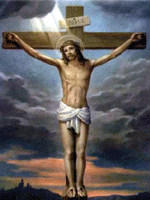
 Christianity is one of the major religions of the world. It is a monotheistic (believing in the existence of a single God) religion based on the teachings of Jesus Christ and the people who observe this religion are known as Christians. It originated in the East Mediterranean Coast but has now become, ubiquitous. The Christian beliefs and practices revolve around the teachings of Jesus Christ or the Messiah who is considered to be the son of God. He was believed to have come onto this Earth as a human being to guide his children through the path of love and tolerance. The mainstream religion says that the doctrine of Trinity implies the belief in one god consisting of three persons: the Father, the Son (Christ) and the Holy Spirit. The holy book of Christianity is the Bible which consists of the Old Testament (close to the Jewish Bible) and the New Testament (scriptures). Christians strictly adhere to religious dogmas and yet there are differences in the interpretation and opinion of 'The Bible'. Regardless of these boundaries, this religion urges us to be good human beings. Read on to learn more facts about Christianity.
 Founder
Christianity is centered on the crucifixion, death and resurrection of Jesus Christ who was the Son of God. The chief source of information about the life of Jesus is the Gospels, which are four books written by different authors from 30 to 100 years after Jesus' death. It was these books that became a part of the New Testament. The Gospels depict a three-year teaching and healing practice advocated by Jesus and propagated through his disciples - the twelve Apostles and other followers who believed him to be the Messiah or the Christ.
Most of these teachings are greatly focused on the kingdom of God, love of God and love of neighbor. With his soft nature and passion for human good, Jesus Christ started gaining enormous popularity among the people. Disturbed Jewish religious leaders and the Roman government considered it a threat to the existing belief. They accused Jesus of claiming to be the 'King of Jews' and 'Son of God' and decided to give him the ultimate punishment, execution by crucifixion. It is believed that Jesus Christ rose from the dead, three days after his burial and this is commonly referred to as the 'Resurrection'.
History
Christianity began as a Jewish sect in the middle of the 1st century. The foundation of this religion dates back to 4 BC, after the death of Jesus Christ. Jesus was born to Virgin Mary in Bethlehem. According to most historians, Jesus was a Jew. It is believed that he took birth as a human to guide the people. Christ was regarded as a teacher and healer and was baptized by John the Baptist. His life stood for love towards humanity. It is said that "Jesus sacrificed his life as a ransom for many".
Christianity originated in the Mediterranean coast of the Middle East (modern Israel and Palestine) and it slowly spread to Syria, Mesopotamia, Asia Minor and Egypt. Over a few decades, this religion gained enormous popularity and it became dominant by the 4th century.
Missionary work and colonization, led to the spread of Christianity to America, Australasia, Sub-Saharan Africa and other parts of the world. As Christ's life and teachings vested upon the ideology to serve others, Christians established health centers, churches, educational establishments, orphanages and shelters for the homeless.
Religious ceremonies vary from place to place but similar customs include Sunday worship, study and reading of the Scriptures and participation in rites such as baptism and communion etc. The most common practice of a Christian includes Sunday mass, devotion to Jesus, Virgin Mary and the saints and reading of the Bible. Others are the recognition of seven total sacraments, veneration of relics and places associated with holy figures. The ultimate goal of a true and religious Christian is to attain Salvation.
Current Status
Now, Christianity is the largest religion in the world with more than two billion followers. There are three major branches of this religion. Roman Catholicism was developed in Western Europe and headed by the Pope. Eastern Orthodoxy was developed in Eastern Europe but refuse to accept the Pope as its religious leader. It stands for the use of icons in worship and celebrating Easter on a different date. Another version of Christianity is Protestantism that originated in 16th century with Germany, Switzerland and Britain as the major centers. Protestants also refuse to acknowledge the authority of the Pope. This sect stands against many traditions and beliefs of the Catholic Church. Protestants believe that Salvation is attained through the strength of belief and also, in importance of reading the Bible. There are numerous denominational groups that are embraced within Protestantism. They include the Lutherans, Baptists, Methodists, Episcopalians, Presbyterians, Pentecostals and Evangelicals.
Christians keep their rituals simple. According to them, marriage is an institution that recommends a lifelong relationship between the husband and wife and is to be 'held in honour'. A Christian wedding ceremony is an expression of worship combined with joy and celebration and thus, it is the foundation of a new family with mutual respect, dignity and love.
Most ceremonies are accompanied by a musical prelude followed by a procession of important family members such as the parents and grandparents of the bride and groom. After this, a bridal procession takes place which includes the entry of the minister and the groom (the groom's men either escort him or enter together with the bridesmaid), the bridesmaid and maid or matron of honour. Next is the wedding march to welcome the bride and her father. The ceremony begins with opening prayer and proceeds to giving away the bride in accompaniment with a worship song, hymn or solo. Wedding pledges and vows are important in cementing this new relationship. It is then that the rings are exchanged between the bride and the groom. It all comes to an end with the lighting of a 'unity' candle and the pronouncement of marriage by the priest.
Pilgrimage
As a global religion, Christians have pilgrimage spots across the world. Some of them are considered holier than the others due to religious importance.